
What is the Caliphs of Bagdad?

For many years, our page on the Caliphs of Bagdad noted that very little was known about the organization. The venerable American Heritage Museum had documented that the group was active in Pennsylvania during the early twentieth century and held two Caliphs fezzes in its collection, both dating from roughly the same period. Beyond that, however, even they had little of the story.
That changed earlier this year when friend of the Museum Matt Cordoves sold us another Caliphs of Bagdad fez, along with an original flyer from the organization. As it turned out, the flyer proved even more valuable than the fez itself.
Based on the information it contains, the Caliphs of Bagdad may have operated only a single local unit: Court No. 1 in New Castle, Pennsylvania. The group met at the Scottish Rite Cathedral in New Castle, a monumental Masonic building that remains in use today.
The location helps explain why such an organization may have developed there. In western Pennsylvania, Syria Shriners dominated the Pittsburgh area, while Zem Zem Shriners were centered in Erie. New Castle sits roughly an hour and a half from either city by modern automobile, and the journey would have been considerably more difficult in the 1920s. At the same time, New Castle had a thriving Masonic community of its own. It appears that local Freemasons simply decided to create their own fez-wearing social organization and have some fun closer to home.
Enter the Caliphs of Bagdad, Court No. 1, organized in 1924.
The flyer dates from December 1929 and advertises a Ceremonial for the initiation of new members. Festivities began at 7:30 p.m. and concluded with a midnight banquet. Membership was restricted to Master Masons, and the presiding officer at the time bore the title Chief Caliph. In 1929, that office was held by H. B. Richards.
Perhaps most intriguing is a reference in the flyer to “The Forty Thieves,” suggesting that the organization’s ritual may have drawn heavily from the story of Ali Baba and the Forty Thieves. There are also several references that strongly suggest the Ceremonial included the sort of lighthearted hazing commonly found in fraternal side degrees of the period.
The petition contained within the flyer provides another fascinating clue. Candidates were required to certify that they were members of “Kennel No. 1, Yellow Dogs of New Castle.” The Yellow Dog degree was another humorous side degree practiced by a number of fraternal organizations, which suggests that receiving the Yellow Dog degree may actually have been a prerequisite for membership in the Caliphs of Bagdad. Fraternalism could get wonderfully complicated.
The initiation fee was $5 in 1929, equivalent to roughly $100 today.
The fez itself is constructed rather than blocked, using two separate pieces of fabric: one forming the conical body and another forming the top. The Caliphs of Bagdad emblem is printed on the front in gold and remains in remarkably good condition. A yellow tassel is attached by a short cord directly through the center of the top.
Compared with many of the other fezzes in the collection, its construction is relatively inexpensive and utilitarian. Nevertheless, the piece has survived in excellent condition for something approaching a century old. More importantly, when paired with the accompanying flyer, it has helped us finally recover a substantial piece of the history behind this obscure little Masonic organization.
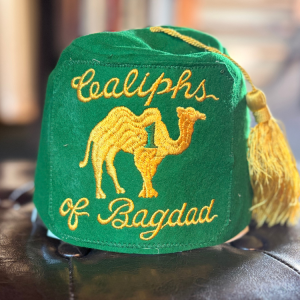
This is the fez that accompanied the Caliphs of Bagdad flyer acquired from Matt Cordoves. Like the other known examples, it is decidedly utilitarian in construction—perhaps even more so. In fact, the fez has an almost homemade appearance.
The emblem on the front is not applied directly to the body of the fez, but instead is embroidered onto a separate patch that was then sewn into place. The tassel is diminutive at best, consisting of a short length of gold-colored string. The fez itself is also quite small overall.
Nothing about its construction would be inconsistent with a date in the 1920s. It is entirely possible that this was made for a local Mason preparing for an evening of good-natured fraternal fun—or, perhaps just as likely, made for him by a patient and accommodating wife.